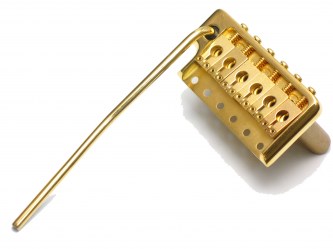
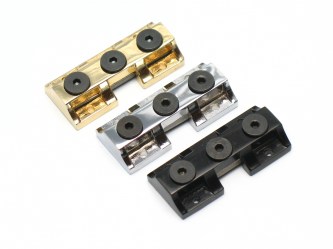
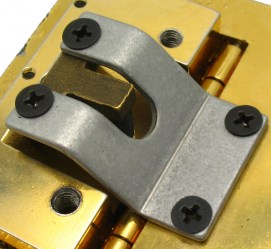
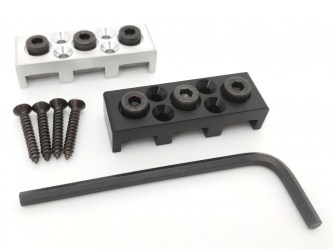
Disclaimer: This is a guide only. We always recommend a qualified luthier do the job. Wammi World is not responsible for any installation errors due to any content on this web site. Installation guidelines: Congratulations on your purchase of the most versatile Bass tremolo bridge system in the world… the Kahler 74xx Series. Installed properly, this device will give you many years of great performance. So please read this entire installation guideline very carefully before beginning to install your new Kahler bass tremolo system. This guideline is simply that ...a guideline. The principles in here apply to every installation of any bridge in the world. In a nutshell you will measure, locate east, west, north and south positioning of the trem, mark it out, route it out, screw it down and set it up. It's that simple. Proper installation requires some knowledge in woodworking, measurements and luthier ship. If you are unfamiliar with any of these things, PLEASE ask a luthier to install it for you. Wammi World will NOT be held responsible for any errors resulting from the use of these guidelines. These guidelines are used for all Kahler Bass tremolos and Fixed bass bridges. But first a little info to get you warmed up... All Kahler bass tremolos and fixed bridges are flat mounting and will work perfectly with P and J bass styles. However P and J basses only make up a fraction of the different bass styles and mounting situations there are out there. Luckily with basses, most don't have a tremolo and therefore don't have any bridge routing done to the body which makes for a perfect installation every time. The flat mounting bass bridges are characterized by a flat chassis, which is simply screwed down flush against the body top over the route (tremolos only). Most basses in general need to have the tremolo or bridge countersunk into the body to achieve the right action and string angle. You can download a routing and sizing template here. As in mounting any type of tremolo or bridge, there are two key words to remember when mounting; alignment and alignment. The principles are the same for installing all bridges. The intonation length must be correct, usually 34” for most basses measured from nut edge to the smallest strings, bridge saddle witness point. Of course there are several other scales both shorter and longer but if you employ the same format (double the distance from the nut to the 12 fret), as you do with a 34" scale (17" x 2) you will get the right results. The front to back, side-to-side placement of the trem must also be correct. Once intonation and side-to-side alignments are made, and the trem or bridge mounted, where do you want your bridge saddles be?” Food for thought.... These guidelines are written for retrofit and new construction, let's get started... Retrofitting: If you are replacing your bass bridge with a new Kahler tremolo, you'll need to do some preparation before removing your existing bridge assembly. Complete these next 3 steps before you work on your new trem.
1) Mark the old bridge spot: Place a strip of masking tape on the surface of the guitar, beneath the strings, just in front of the old (still installed) bridge. If the bridge is missing, skip way down to Step 5. Once you have an intonation line established and drawn out, come back here and continue with Step 2. 2) Mark the old bridge center point: Carefully make a centering mark on the tape between the center two strings of a 4 or 6 string bass or under the 3rd string of a 5 string bass. Make the mark with a ball point pen by holding the pen perpendicular to the surface of the guitar scribbling back and forth from string to string. Grip the pen close to the strings and keep it straight up for most accuracy. Your trying to get the exact center of the bridge area. Another cross check of this would be to take a straight edge long ruler and find the centerline of the dots (see below) on the neck and line up and over the same line you drew earlier. Once this line and the previously drawn intonation line is established and intersecting, the "+" marks the installation sweet spot)... 3) Remove old bridge: Carefully remove the bridge from your bass and retract the ground wire back into the control cavity. Next, remove all the hardware from the body top in preparation for routing. Hint: Knobs can be removed and posts pushed into the control cavity and the neck pickup may not need removal depending on the guitar. Essentially the body should be void of hardware and perfectly flat. Fixed bass bridge installations should skip to Step 5. Refrences for routing for the fixed bridge should be ingnored. 4) Getting your template together and marking it out: Cut out the bass routing template located in the back of your catalog (2400). Or better yet, use a #9538 bass tremolo template because it has precut marks that line up with your intonation lines on the bass. We are using this template and installing a 7410 with rearward saddles for the demonstration pictures. You can see the folds in the sides showing the measuring marks. But if your using the one in the catalog, you can make the marks yourself easily enough but first, cut it out as precisely as possible. Use an exacto knife. Then for rearward facing saddles, measure from the front edge of the template, back to a point 1 and 9/16" inches from the front and mark it. Do this for both sides of the template (measure off 3/8" for forward facing saddles). These are your intonation markers. Now find the centerline of the template by measuring the width of the inside hole of the template, and split the difference, make a mark on the front edge and your ready to go... FYI: For whatever reason, the mounting holes on the template were not marked out...no big deal, just do this: take the template and place it under the trem. Mark the mounting holes out with a pen using the trem as a guide. Punch out the marks with a sharp needle or pen and turn them into small holes.
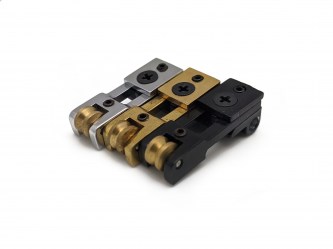
Fixed bass bridge installs click here to continue, otherwise all tremolo installs move on to step 6. Mounting the Tremolo for the first time... 8) The pre-setup of the tremolo: 9) Slightly loosen the phillips on top of the middle of each saddle. Pull out and measure the fork. HINT: you can measure the gap between fork body and the sandwiching plates to get this measurement. For 24xx models with forward saddles pull out each saddle fork about 3/8" - 7/16" of of an inch and line them up equally. For 241x & 741x models with rearward saddles pull out each saddle fork about 1/8" - 3/16" of of an inch and line them up equally, secure them by lightly re-tightening the Phillips screws (right) 10) Now take the saddle height risers and screw them down into the fork, raising the saddles 2/3rds or about 10:00 o'clock (left) Although your Kahler is adjustable for height, It is best kept around this range. The Kahler works best and has the most resonance and tone at this height because the string has proper pressure on the roller at all times including the slack time, during dive bombing. If you go any lower, it should be for radiusing your strings. Please note: You can go higher with the saddles and not hurt tone or resonance, but be careful the adjuster doesn't come out the bottom if you twist to far. 11) If needed, or for new construction, drill a ground wire tunnel between the Kahler cavity and the control cavity. Run the ground wire into one of front screw holes or lay it over body route edge so the mounted trem lays on it. Always keep the wire near the front of the route and farthest away from the swiveling cam. Never use the spring screw to mount a ground wire. 12) Screw the tremolo or bridge into place with mounting screws supplied. 13) Intonate your bass: Proper intonation will assure that your bass plays perfectly up and down the fret board and plays in perfect tune at each fret, at least as perfect as possible since perfect intonation is physically impossible. Setting the intonation on your bridge is easy, especially if you have a Kahler Cam system. All you have to do is know a few rules of the road. The simplest test for correct intonation is to strike the harmonic at the 12th fret and then play the 12th fret. By comparing the notes, you can determine if your intonation is out of whack or if it’s right on the money. But the human ear is not perfect. You really need a visual reference.... you need an electronic tuner or to get even a more precise intonation experience, you need a strobe tuner. But strobes are expensive and shelling out several hundred bucks to intonate a few guitars is not necessary unless you’re getting into the biz. A good quality electronic tuner with a needle will do just fine. So to start…. 15) Tune your bass to standard 440 tuning using an electronic guitar or bass tuner. 16) Once tuned up, lightly touch your finger on the smallest string right over the 12th fret and strike it for a harmonic sound. The tuner should read dead on zero because you just tuned it right? 17) Next, actually play the 12th fret. Don’t push hard. You don’t want to stretch the string over the fret giving you a false reading. Watch the tuning line. If the needle goes to the right of zero, the string is sharp…you need it longer. Left of zero means its flat…you want to shorten the string. Note: If the needle is erratic, lower the neck pickup volume and or the neck pickup a bit. You’re now ready to move on to the next step... FYI: On all Kahler Cam systems, each saddle has a fork with a roller, the fork slides back and forth through the clamp plates. Barely loosen the Phillips just enough while keeping some clamp plate tension/grip so it won’t be necessary to re-tighten between re-tunings and re-tests. 5D) If the string is sharp, or to the right of the mark, it needs to be made longer. Barely loosen the Phillips in the saddle clamp plate and push in (forward saddles, 24xx) or pull out (rearward saddles 241x & 741x) a tiny little bit, effectively lengthening the string. If the needle shows to the left of the zero mark, the string is flat and the string length needs to be shortened. Move the saddle fork a little toward the pickups.The idea here is to get the both open and fretted notes to be exactly the same on all 6 strings. They should match exactly at zero. 6D) Once all the strings are intonated, tighten the Phillips and double check each string for intonation. Redo them if necessary. Maintenance of your Hybrid... For Kahler bass tremolos, just oil the rollers, tuners and all threads with “3 in 1” household oil for smooth operation every few months. Change the springs every 3-5 years as recommended, and keep the unit clean from dirt and debris. Otherwise its built like a tank and setup correctly will last a long time and give you years of maximum enjoyment and top notch performance. When installed properly, the Kahlers work incredibly well. But installation oversights can cause these systems not to perform up to par. If the tuning isn't returning to correct pitch after dive bombing, check the feel of the arm for smoothness. Does it feel like the system is dragging or catching on something as it moves? Check the tremolo cavity for obstructions. The cam should not touch any wood when at rest. This will prevent the system from returning to pitch. On all Kahlers, the angle of the string across the rollers should have a definite bend to it. A shallow angle can and will cause string rattle. All bass players are after the lowest action possible. Its our quest in life, next to tone... right? But players tend to drop the saddles too low in an effort to get that perfect action. This is not a good thing for sustain and tone. That's why you setup your bass around the tremolo. On the other end of the bass, the nut should be Teflon and the tuners should be locking types like Sperzel's.
|
||||||||||||||||||||||||
|
||||||||||||||||||||||||